

“论文写得再好,长难句一扎堆,审稿人直接没耐心”—— 这是无数科研人投稿 SCI 的血泪教训。英文长难句堪称 SCI 写作的 “隐形杀手”:要么嵌套多层从句让逻辑混乱,要么修饰成分堆砌掩盖核心观点,轻则降低阅读流畅度,重则导致审稿人误解研究价值,直接影响录用率。其实,SCI 长难句拆分从不是 “越短越好”,而是要在保留学术严谨性和提升可读性之间找到平衡。
先抓 “主谓宾主干”,再拆 “修饰枝叶”
长难句的本质是 “主干 + 多层修饰”,就像一棵大树,主干是核心观点,定语、状语、插入语等修饰成分是枝叶。拆分的第一步,必须是 “先砍枝叶,露主干”—— 先锁定主语、谓语、核心宾语,再将修饰成分转化为独立短句或依附于主干的简单结构。
实操技巧:
快速识别主干的 3 个步骤:①找谓语动词(排除非谓语动词 doing/to do/done);②确定动作的发出者(主语)和承受者(宾语);③剔除介于主谓之间的插入语和过长介词短语。
修饰成分拆分优先级:定语从句>分词短语>介词短语>插入语,拆分后用代词(this/these/it)或逻辑词衔接,避免信息断层。
禁忌:不可拆分主干本身,比如不能把 “Recent advances demonstrate potential” 拆成 “Recent advances. Demonstrate potential”。
多学科示例(生物领域):
原句(冗长修饰掩盖主干):
“Recent advances in CRISPR-Cas9 technology that enable precise gene editing in mammalian cells and have been applied to treat genetic disorders such as sickle cell anemia in preclinical studies demonstrate great potential for clinical translation.”
(主干:Recent advances demonstrate potential;修饰成分:定语从句 + 介词短语 + 举例)
拆分后(主干突出 + 逻辑连贯):
“Recent advances in CRISPR-Cas9 technology demonstrate great potential for clinical translation. This technology enables precise gene editing in mammalian cells and has been applied to treat genetic disorders (e.g., sickle cell anemia) in preclinical studies.”
审稿人视角:
拆分后先抛出核心结论,再补充技术细节,符合 “结论先行” 的学术阅读习惯,让我 3 秒就知道这项研究的价值所在。
逻辑优先:
按 “语义关系” 拆分,拒绝机械断句
学术写作的核心是 “传递逻辑”,长难句中常隐藏因果、转折、并列、递进等关系。拆分的关键不是 “哪里长拆哪里”,而是以 “逻辑关系” 为边界,让每个短句对应一个逻辑单元,避免跨逻辑拆分导致歧义。
不同逻辑关系的拆分策略:
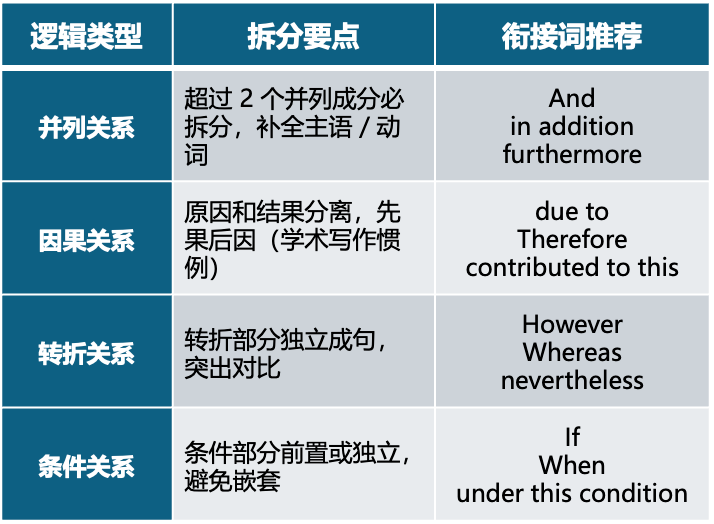
实操示例(化学领域 - 因果关系):
原句(原因嵌套导致逻辑模糊):
“Because the sample was contaminated during pretreatment and the detection limit of the instrument was insufficient, the experimental results failed to meet the expected accuracy.”
拆分后(逻辑清晰 + 重点突出):
“The experimental results failed to meet the expected accuracy. Two main factors contributed to this: first, the sample was contaminated during pretreatment; second, the detection limit of the instrument was insufficient.”
避坑提醒:
并列结构拆分时,避免 “省略式冗长”。比如原句有 3 个并列谓语,拆分后补全代词,让每个短句语法完整,不要出现 “detects..., quantifies..., and transmits...” 的拖尾结构。
简化从句:
嵌套从句 “分层拆解”,不超过 2 层嵌套
SCI 论文中最头疼的是 “从句套从句”,比如 “定语从句套状语从句”“宾语从句套同位语从句”,这类句子的可读性会随着嵌套层数呈指数下降。拆分核心是 “一层从句对应一个短句”,用连接词或代词衔接,坚决杜绝超过 2 层嵌套。
常见从句的拆分方法:
定语从句(修饰名词):从句长度>10 词时,拆为独立句,用 “this/these + 名词” 替代 which/that。
状语从句(表时间 / 条件 / 让步):拆为独立句,用 “when/if/although” 开头,或转化为介词短语。
同位语从句(解释抽象名词):拆为独立句,用 “specifically/in other words” 衔接,让定义更清晰。
实操示例(工程领域 - 嵌套从句):
原句(2 层嵌套,可读性差):
“The study which was conducted by Smith et al. (2023) in three different ecosystems where temperature and humidity vary significantly found that microbial diversity is positively correlated with soil fertility.”
拆分后(分层表达 + 逻辑连贯):
“Smith et al. (2023) conducted a study in three different ecosystems. In these ecosystems, temperature and humidity vary significantly. Their results showed that microbial diversity is positively correlated with soil fertility.”
快速套用模板:
“研究者 + 研究行为→研究环境 / 条件→研究结果”,适用于绝大多数包含实验设计的长难句拆分。
剥离插入语:
避免主干 “被割裂”,让表达更连贯
长难句中常插入补充说明(如作者引用、数据范围、定义解释),导致 “主语 - 插入语 - 谓语” 的断裂结构,让读者读着 “卡壳”。拆分时需将插入语剥离,要么独立为句,要么移至句首 / 句尾,确保主干连贯。
常见插入语类型及处理方式:
引用类插入语(according to XXX, 2023):移至句尾,用括号标注,或独立为句。
数据类插入语(with a yield of 85%):移至句尾,或拆为独立短句 “Its yield reached 85%”。
定义类插入语(a protein that regulates cell cycle):拆为 “名词 + 独立定义句”,如 “This protein regulates cell cycle”。
实操示例(材料领域):
原句(插入语割裂主干):
“The new catalyst, which is composed of palladium nanoparticles supported on graphene oxide and has a specific surface area of 120 m²/g, exhibits higher catalytic activity than traditional catalysts in the hydrogenation reaction, as reported by Lee et al. (2024).”
拆分后(主干连贯 + 细节清晰):
“The new catalyst exhibits higher catalytic activity than traditional catalysts in the hydrogenation reaction (Lee et al., 2024). It is composed of palladium nanoparticles supported on graphene oxide, with a specific surface area of 120 m²/g.”
小贴士:
插入语长度≤5 词时可保留在句中,如 “(i.e., pH=7.0)”;长度>5 词时必须独立,避免打断阅读节奏。
控制长度:
单句≤25 词,拒绝 “过度拆分”
拆分的目的是 “简化表达”,而非 “制造碎片化”。学术写作中,单句理想长度为 15-25 词,最长不超过 30 词;若 1 个长句拆为 4 个以上短句,需合并逻辑相关句子,用连接词衔接,避免 “句子孤岛”。
长度控制的 3 个技巧:
一个长句最多拆为两到三个短句,确保逻辑连贯。
短句间用代词(this/these/it)或逻辑词衔接,让句子 “串起来”。
专业术语首次出现后用缩写替代,减少重复(如 “CRISPR-Cas9 technology” 首次出现后可写为 “CRISPR-Cas9”)。
反面示例(过度拆分):
原句:“We synthesized a series of copolymer materials and tested their mechanical properties under different temperatures and pressures to evaluate their applicability in aerospace engineering.”
❌错误拆分(碎片化):
“We synthesized a series of copolymer materials. We tested their mechanical properties. The tests were under different temperatures and pressures. We aimed to evaluate their applicability in aerospace engineering.”
✅正确拆分(逻辑合并):
“We synthesized a series of copolymer materials and tested their mechanical properties under different temperatures and pressures. Our goal was to evaluate their applicability in aerospace engineering.”
工具推荐:
用 Grammarly 的 “可读性评分” 功能检测句子长度,目标是让 “平均句长” 保持在 20 词左右,可读性评分≥60 分。
学术规范:
拆分后保留 “被动语态 + 正式性”
SCI 论文强调 “客观陈述”,拆分时需避免两个误区:一是过度使用主动语态(如滥用 “We found”),二是为了简化而丢失专业细节。核心原则是:拆分不改变学术规范,不遗漏关键信息。
学术规范的 3 个要求:
语态使用:实验结果、结论类句子优先用被动语态(如 “Data were analyzed” 而非 “We analyzed data”),拆分后不改变语态。
细节保留:专业术语、缩写、引用标注(作者、年份、DOI)必须完整,拆分时不遗漏。
正式性:避免口语化表达(“got”→“obtained”,“very good”→“promising”,“think”→“suggest”)。
实操示例(环境领域):
原句(主动语态 + 口语化):
“We got some promising results: the new adsorbent can remove 92% of heavy metals from wastewater, which we think is better than previous materials.”
优化拆分(被动语态 + 正式性):
“Promising results were obtained: 92% of heavy metals in wastewater can be removed by the new adsorbent. This performance is superior to that of previous materials.”
审稿人视角:
被动语态让研究更客观,正式表达体现学术素养,拆分后既清晰又专业,好感度直接提升!
长难句拆分的 “黄金公式”
长难句拆分 = 抓主干(主谓宾)+ 按逻辑拆修饰(从句/短语)+ 控长度(15-25 词/句)+ 保衔接(代词/逻辑词)+ 守规范(学术正式性)。
核心目标是:让审稿人在 3 秒内 get 句子核心信息,同时不牺牲学术严谨性。
撰写时可遵循 “先写长句,再拆分优化” 的流程;修改时通读短句,检查 3 个问题:逻辑是否连贯?信息是否完整?表达是否正式?